

From brewery waste to sustainable aquaculture: A holistic success story2026-06-19
Innovation in sustainable food systems requires more than isolated solutions — it calls for collaboration, integration, and a truly holistic way of thinking. This is precisely what the European project ALGAEBREW is delivering.
In a recent study published by Aquaculture Nutrition, researchers from the Fish Nutrigenomics and Integrative Biology Group (IATS-CSIC, Spain), the UCD Algae Group (University College Dublin, Ireland), the Bioscience Department at Swansea University (UK), and the industrial partner LSAqua (Belgium) - have joined forces to explore how microalgae can help reshape aquaculture sustainability. The significance of these findings has led to the publication of an official press release, featured jointly on the main CSIC website and by the CSIC Delegation in the Valencian Community.
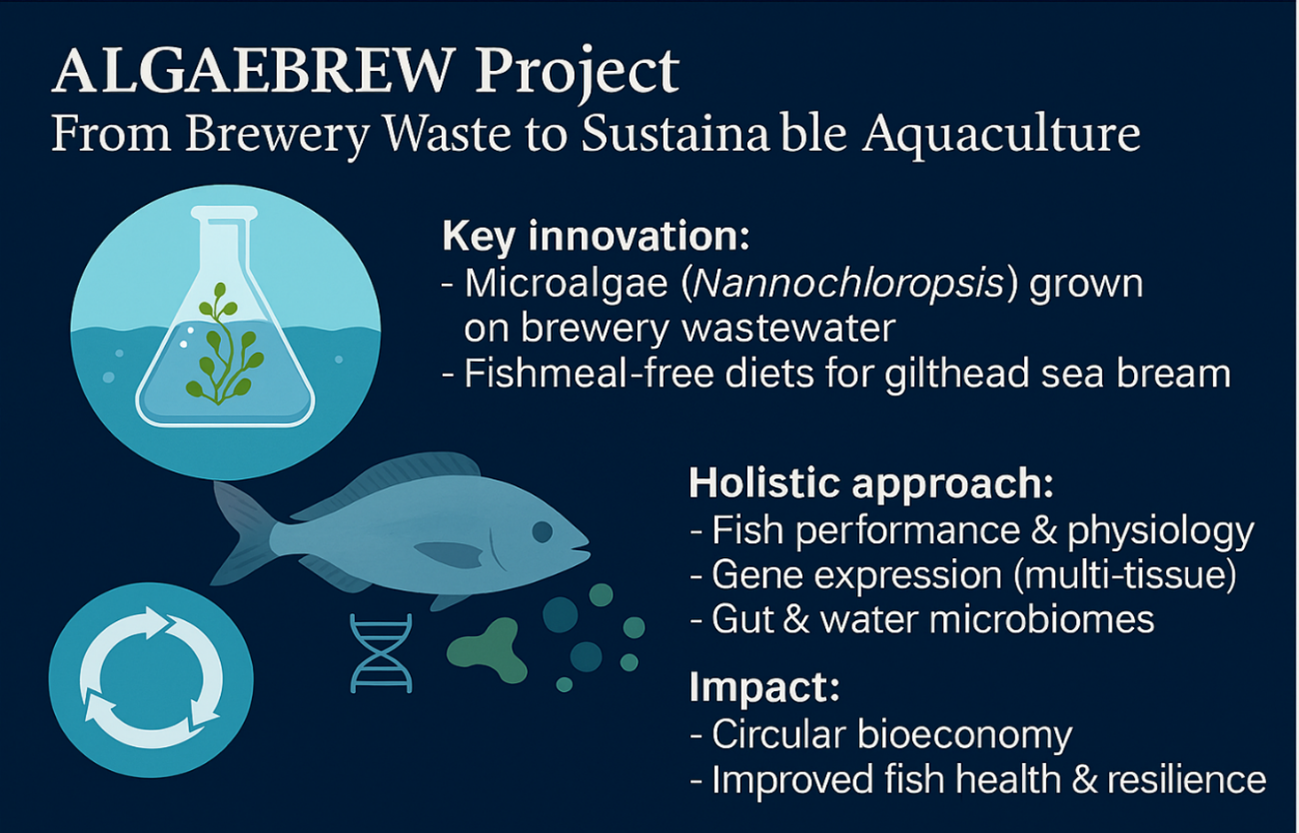
At the core of this work lies an innovative idea: transforming brewery wastewater into a valuable resource by cultivating the microalga Nannochloropsis oceanica, and using this biomass as an ingredient in fish feed. The results are highly encouraging. Fishmeal-free diets formulated with this microalga were able to maintain growth performance in gilthead sea bream (Sparus aurata), while also improving key health indicators such as antioxidant capacity and immune-related responses.
But what truly sets this study apart is not just the results - it is the way the problem is approached. Rather than focusing on a single parameter, the research embraces a holistic framework, integrating multiple biological and environmental levels. From growth performance and physiology to multi-tissue gene expression, gut microbiota, and even the microbial communities present in the surrounding water, the study provides a comprehensive view of how nutrition interacts with both the animal and its ecosystem.
This integrative perspective reveals something essential: feeding strategies do not only influence fish growth, but also shape microbial dynamics and ecosystem health. In other words, nutrition becomes a powerful tool to enhance not just productivity, but also resilience and sustainability across the entire aquaculture system.
At the same time, the work stands as a clear example of circular bioeconomy in action - turning industrial waste streams into high-value, omega-3-rich feed ingredients, reducing dependence on traditional marine resources, and contributing to more climate-smart production systems.
Ultimately, This ALGAEBREW study highlights how interdisciplinary collaboration between research groups and industry, combined with a systems-level understanding, can unlock innovative solutions to some of the most pressing challenges facing the aquaculture sector today.
A step forward towards smarter, more sustainable, and truly integrated aquaculture systems.