

Two sequencing technologies, one goal: exploring the sea lice microbiome in salmon farming2026-05-15
Sea lice (Lepeophtheirus salmonis) are one of the major health challenges in salmon aquaculture. They not only affect fish directly, but can also act as potential vectors of microorganisms that may influence fish health.
That is why investigating the bacteria they host is key
A recent study published in the Journal of Fish Diseases, carried out within the European AQUAEXCEL3.0 project, brought together Irish and Spanish researchers from the University of Galway (Marine Institute of Ireland), and the Fish Nutrigenomics and Integrative Biology group (Institute of Aquaculture Torre de la Sal – CSIC) with the aim of characterize the gut microbiome of sea lice, evaluate their potential as pathogen carriers, and compare the performance of short- and long-read sequencing technologies: Illumina and Nanopore.
What did they find?
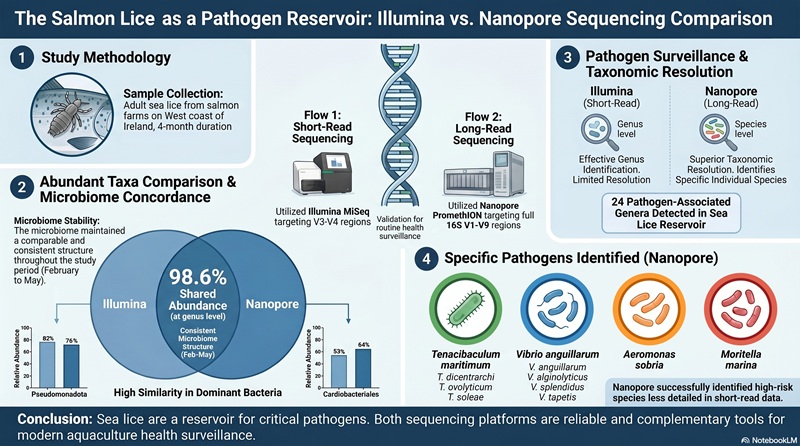
Both platforms produced very similar results when analysing the most abundant bacteria in sea lice, identifying Pseudomonadota as the dominant phylum (representing more than 75% in the two communities), and similar key bacterial taxa, meaning that the overall structure of the core microbiota was consistent with both technologies.
Why is this important?
Because it confirms that different sequencing technologies can be reliably used to study and monitor fish parasites in aquaculture as potential vectors of microorganisms, an essential step toward improving fish health management in salmon farming.
In addition, Nanopore provided added value by enabling more precise species-level identification, detecting up to 15 potential pathogens, including bacteria associated with relevant fish diseases.
Overall, this study reinforces the idea that exploring the sea lice microbiome to better understand its role is crucial to addressing one of the biggest challenges in the salmon farming industry.