

New evidence reveals the impact of semi‑synthetic cellulosic fibers on the environment and aquaculture production systems2026-02-23
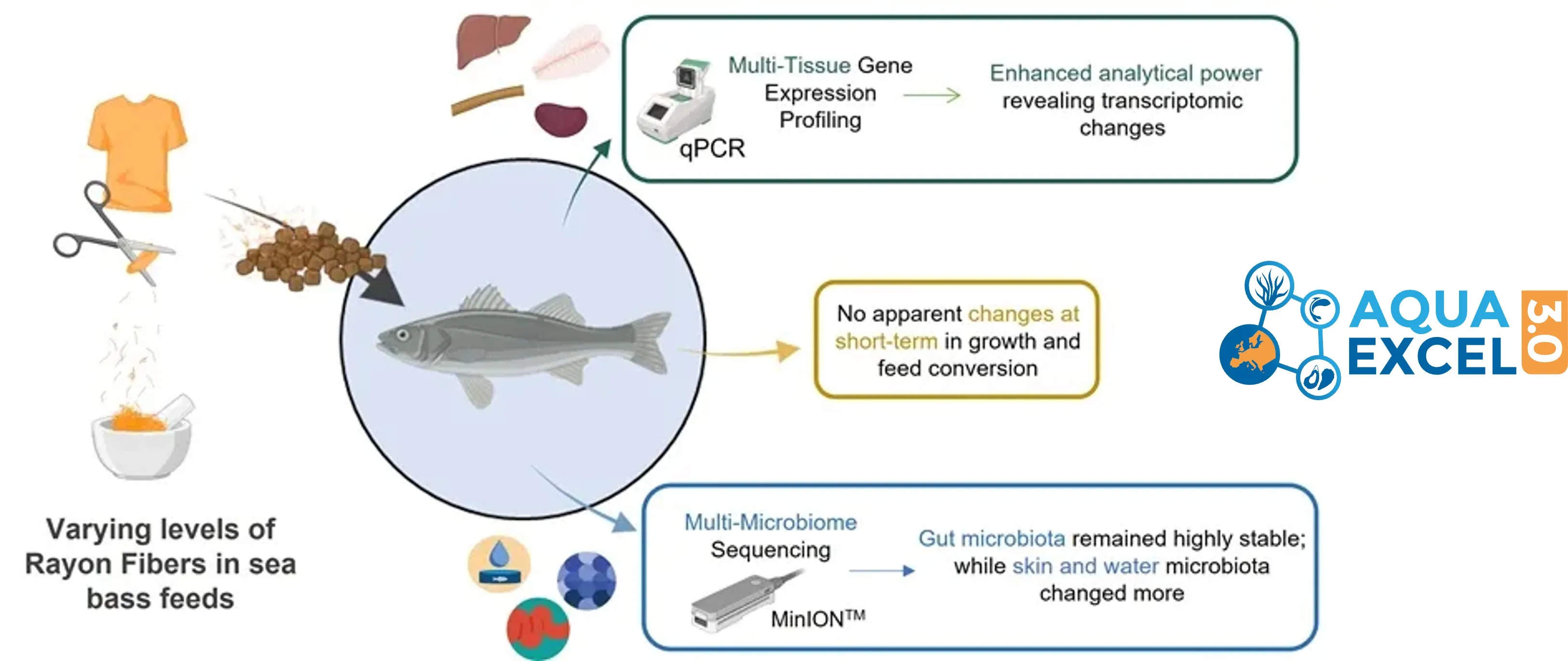
An international team of researchers from the Nutrigenomics and Integrative Fish Biology Group at the Institute of Aquaculture Torre de la Sal (IATS‑CSIC), the University of Porto, and CIIMAR has evaluated within the framework of two transnational access projects of the infrastructures European project AQUAEXCEL3.0 how the presence of rayon microfibres in the diet affects the physiology and microbiome of juvenile European sea bass. The study applies a holobiont perspective, considering the host and its associated microorganisms as a single biological unit.
Although no significant changes were detected in growth or feed conversion, a multi‑tissue transcriptomic analysis revealed a strong discriminatory capacity that was not observed when the same analysis was performed independently on liver, skeletal muscle, intestine or head kidney.
Microbiome analysis also showed a differential pattern with a clear gradient: the intestinal microbiota proved to be considerably more resilient than that of the skin and the surrounding water. This is indicative of the differing degrees of resilience to environmental disturbances.
The results have been published in two high‑impact environmental journals: Environmental Pollution and Environmental Microbiome. These studies provide new evidence that semi‑synthetic cellulosic fibres can affect both farmed fish and their associated ecosystems. Although they are often considered more sustainable than petroleum‑derived plastic pollutants, the environmental impact of synthetic microfibres on aquaculture production systems cannot be overlooked. This points to the importance of new holistic approaches to monitor the effects of these and other emerging contaminants.